
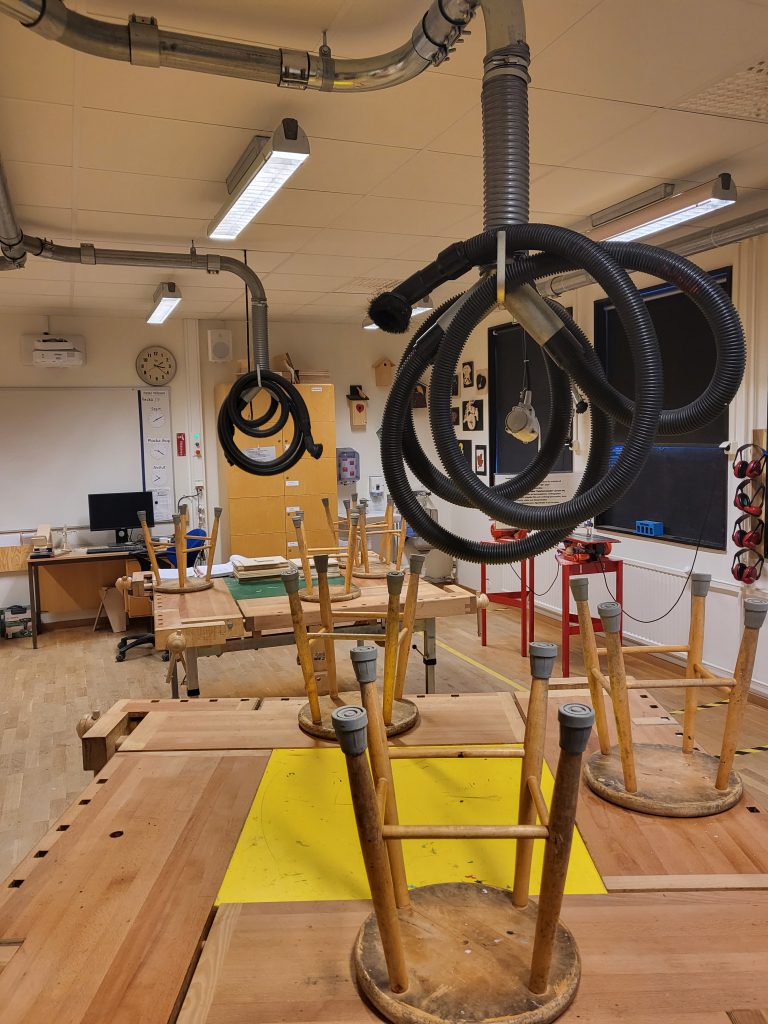
– a solution for cleaner air, a better working environment and a safe learning environment
In a woodwork room, wood shavings and dust are produced during almost every stage of the work. When pupils are sawing, planing or sanding, particles are released that quickly become airborne. Without an effective solution, this risks having a negative impact on both the working environment and the teaching.
Here's where it takes place eager to get started a crucial role. It is not merely an accessory to the machines – but a prerequisite for creating a safe and functional craft room.
That is why chip extraction systems are needed in woodwork rooms
Wood dust is not just a cleaning issue. If inhaled, it can affect your health, particularly with repeated exposure. The Swedish Work Environment Authority make it clear that pollutants must be captured as close to the source as possible – which is the basis for what is known as process ventilation.
In practice, this means that a chip extractor should collect dust and chips directly at the machine, before they spread throughout the workshop.
An effective chip extraction system helps to:
- Cleaner air and reduced dust dispersion
- Better visibility and safer working procedures
- Less cleaning between lessons
- Longer service life for machinery
- A more focused and educational working environment
How a chip extractor works in practice
A chip extractor is connected to the machines that generate the most chips and dust, such as rip saws, band saws and planers. When the machine is in use, an airflow is created that extracts the particles directly at source and carries them away via hoses or a pipework system.
The key factor is that extraction takes place close to the processing area. If the dust has time to spread throughout the room before it is captured, the effectiveness is greatly reduced. Therefore, both the location and the capacity are crucial.
Sizing – the key to making it actually work
One of the most common challenges in woodwork rooms is that the chip extraction system is not designed to meet actual needs. It may work for individual machines, but is not sufficient when several are in use at the same time.
To achieve the right effect, you need to start by:
- How many machines are used in parallel
- Which machines produce the most swarf?
- Connection dimensions (e.g. 100–160 mm)
- Length and design of the pipework
In smaller craft rooms, a simpler solution may suffice, but in most cases a fixed dust extraction system with sufficient capacity to handle several machines at once is required. In such cases, it is often better to invest a little more from the outset than to have to upgrade later on.
Choosing a chip extraction system – which solution is right for you?
The choice of system depends on how the craft room is used. Mobile chip extractors can be an option in smaller spaces or where machines are used one at a time. They are flexible, but require more manual handling.
In most schools, however, a stationary chip extractor connected to a fixed pipework system is the most practical solution. It offers more consistent performance, a better working environment and less dependence on how the equipment is being used at any given moment.
For larger halls or new builds, a centralised system may be appropriate, whereby several machines are connected to a single high-capacity system with scope for future expansion.
Things to consider before buying
To achieve a solution that works in the long term, chip extraction must be viewed as part of the overall system – not just as a single product.
It is all about ensuring the right capacity, the right specifications and a solution that is easy to use on a day-to-day basis. Noise levels, filtration and reliability are also important factors in a school environment, where the equipment is used daily by many different people.
Many modern chip extractors also offer smart features such as automatic start/stop and more efficient filtration, making them better suited to today’s requirements in terms of both workplace health and safety and energy efficiency.
Summary – an investment in both safety and education
A chip extractor in a woodwork classroom is not just a practical solution for dealing with wood shavings. It is a key component of a safe working environment and effective teaching.
By following the principles of process ventilation and designing the system correctly from the outset, you can create a craft room where pupils and teachers can work in a cleaner, safer and more efficient environment.
It makes a difference – every day.