
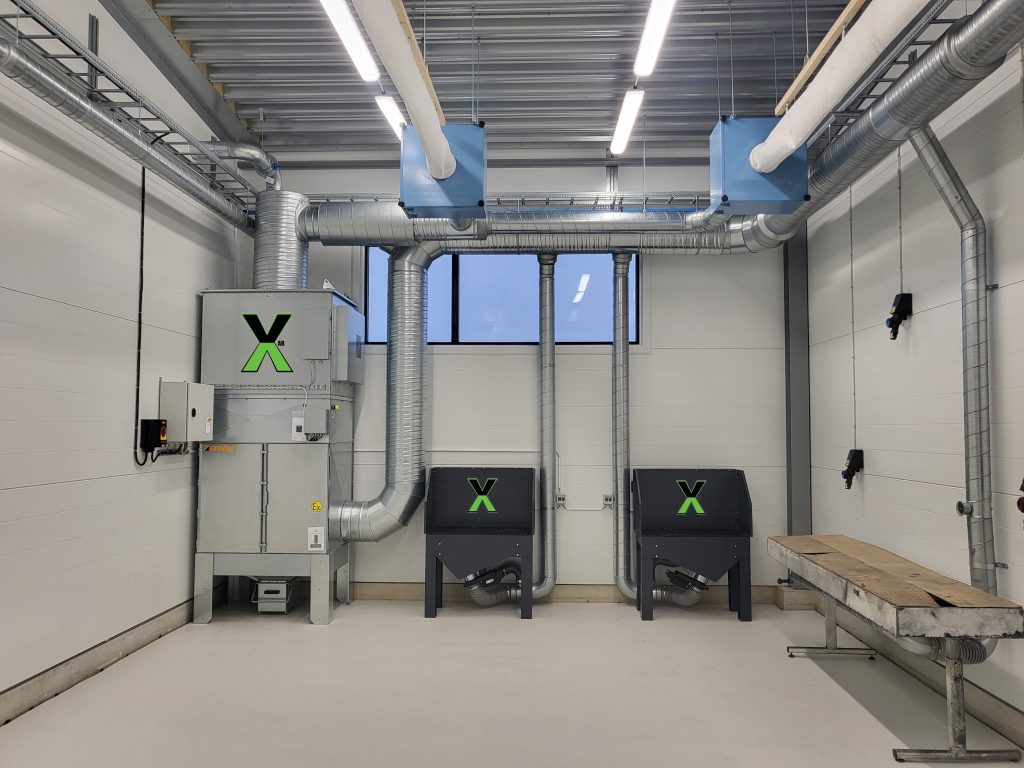
Process ventilation is a ventilation solution designed to capture and remove airborne pollutants directly at the source where they arise. Unlike general ventilation, which ventilates the entire room, process ventilation focuses on limiting the spread of harmful substances at an early stage. According to the Swedish Work Environment Authority This is a key principle for ensuring good air quality and a safe working environment.
Why is process ventilation important?
In many workplaces, air pollution can occur that may be harmful to health. These can include dust, smoke, gases, vapours or chemical particles. If these spread throughout the premises, employees risk being exposed to substances that may, in the long term, cause discomfort or illness.
The Swedish Work Environment Authority emphasises that pollutants should primarily be removed at the source. Process ventilation therefore reduces both exposure and the spread of pollutants, making it a key part of preventive health and safety work.
How does process ventilation work?
Process ventilation works by creating a directed airflow that captures pollutants close to the source. Common technical solutions include:
- Local exhaust ventilation at workstations
- Fume cupboards in laboratory environments
- Covers and enclosures for machinery
- Extraction systems integrated into production equipment
Effectiveness depends largely on how close to the source the contamination is captured. The earlier in the process it is removed, the less it spreads throughout the premises.
Key requirements and guidelines
For process ventilation to function as intended, more is required than just installation. The Swedish Work Environment Authority highlights several key factors:
- Correct sizing – the system must be tailored to the needs of the organisation
- Correct use – the equipment must be used correctly in day-to-day work
- Maintenance and inspection – Regular servicing ensures that the equipment remains in good working order
- Education – staff need to understand how to use the system
A flawed system can provide a false sense of security and thus pose risks.
Process ventilation in relation to other measures
Process ventilation is often a key solution, but it is rarely used on its own. In practice, it is often combined with:
- General ventilation
- Risk assessments
- Air quality monitoring
- Personal protective equipment where necessary
The employer is responsible for ensuring that exposure to air pollution remains at an acceptable level and, where necessary, for carrying out measurements against the applicable limit values.
Summary
Process ventilation is a targeted ventilation solution that captures pollutants directly at the source. When properly designed and used, it is an effective method for reducing health risks and improving the working environment. At the same time, it requires correct sizing, continuous maintenance and a conscious approach to be fully effective.