
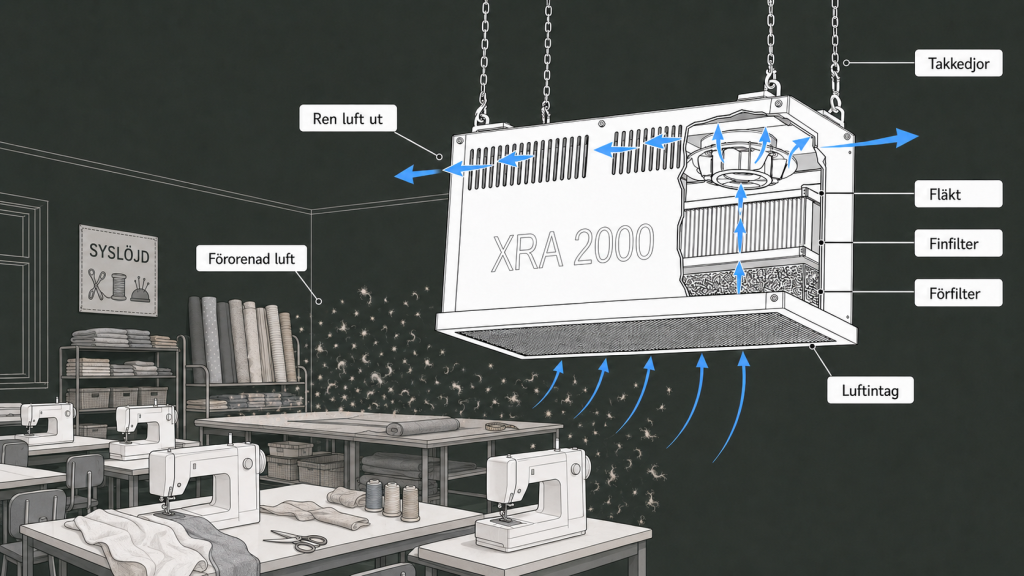
One air purifier is used to reduce the amount of dust and other particles that have already become airborne. It is commonly found in workshops, industrial premises, schools, warehouses and other premises where materials are processed or handled. The aim is to improve air quality and reduce the amount of dust that settles on work surfaces, machinery and other equipment.
The air purifier circulates the air in the room
An air purifier works by a fan drawing in polluted air from the room through an air inlet. The air is then passed through one or more filters before the purified air is blown back into the room.
As the air circulates through the unit several times, the amount of airborne particles gradually decreases. How quickly the air is purified depends, amongst other things, on the air purifier’s capacity, the size of the room and the amount of dust that accumulates.
The filters capture various particles
Many air purifiers use several stages of filtration. A pre-filter traps coarser dust, fibres and other larger particles. At the same time, it protects the subsequent fine filter from becoming clogged too quickly.
The fine filter captures smaller particles that pass through the pre-filter. The type of filtration required depends on the type of dust present in the premises. It is therefore important to choose a filter based on the nature of the business and the particles to be removed.
The air purifier captures particles in the air in the room
Unlike a localised extraction system, an air purifier does not normally capture dust directly where it is generated. Instead, it deals with particles that have spread throughout the room and are still suspended in the air.
The air purifier should therefore be regarded as a complement to local exhaust ventilation, process ventilation and routine cleaning. In the case of dust-generating machinery, particles should primarily be captured close to the source. The air purifier then helps to reduce the dust that the local exhaust ventilation has not captured.
The location affects air circulation
For the air purifier to work effectively, the air must be able to circulate freely throughout the premises. Depending on the model and the nature of the business, the unit can, for example, be fitted to the ceiling, mounted on a wall or used as a portable solution.
Air inlets and outlets must not be blocked by machinery, storage shelves or other objects. Their positioning must also be adjusted so that the purified air is distributed throughout the room without creating disruptive draughts at workstations.
The filters need to be checked regularly
As the filters collect dust, the resistance in the air purifier increases. A clogged filter reduces the air flow and impairs the purification capacity. The pre-filters therefore need to be cleaned or replaced at regular intervals, whilst the fine filters should be replaced depending on usage and in accordance with the manufacturer’s recommendations.
How often maintenance is required depends on the amount of particles in the air and how many hours the air purifier is used for. Regular checks of the filter and air intake help the unit to maintain its performance.
The right air purifier delivers better results
How well an air purifier works depends, amongst other things, on the air flow, filter class, placement and the volume of the room. The unit needs to be able to circulate a sufficiently large proportion of the room’s air to have a noticeable effect.
In smaller premises, a single air purifier may be sufficient, whilst larger or dustier areas may require several units. With the correct sizing and regular filter maintenance, the air purifier can help to ensure cleaner air, reduce the spread of dust and create a cleaner working environment.