
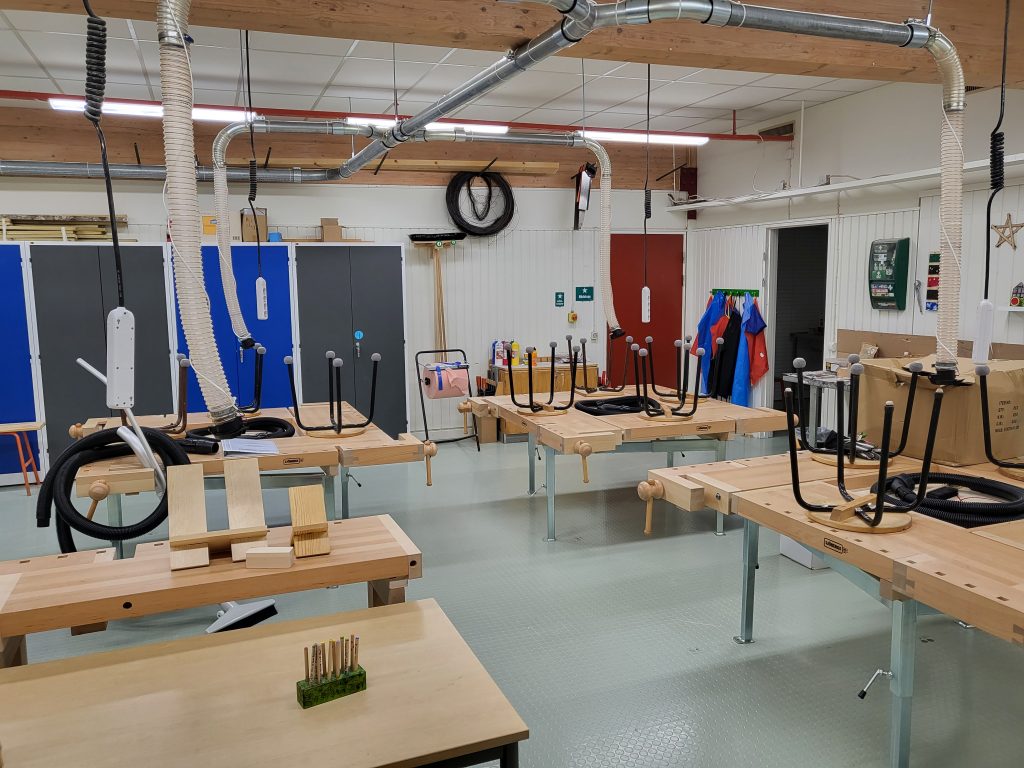
One chip extraction It is used to collect shavings, dust and particles produced during the machining of materials such as wood, plastic or composite materials. It is commonly found in joinery workshops, general workshops and industrial settings where machines such as saws, planers, routers and grinders are used. The aim is to keep the working environment cleaner, protect the machinery and reduce the amount of dust in the air.
The chip extractor creates an air flow
A chip extraction system works by means of a motor driving a fan that creates a powerful airflow. Air is drawn in through hoses or pipes connected to the machine where the chips are produced. As the air moves through the system, chips and dust are carried along with it and removed from the work area.
Unlike a standard vacuum cleaner, a chip extractor is designed to handle larger volumes of air and coarser materials. This makes it particularly effective for use with machines that produce large amounts of chips, such as planers, circular saws, band saws and CNC machines.
The extraction system collects the shavings at source
For the chip extraction system to work effectively, the extraction point must be positioned as close as possible to the source of the chips. Many machines therefore have special connections for chip extraction. By connecting a hose or pipe directly to the machine, chips and dust can be captured before they spread throughout the workshop.
An effective extraction system reduces the need for cleaning and makes the workplace both safer and more pleasant. It also improves visibility and reduces the risk of swarf accumulating in or around the machine.
Wood shavings and dust are separated from the air
Once the wood shavings have been sucked up, they are transported to a collection chamber. In simpler wood shaving extractors, the material is often collected in a bag or container. The air then passes through a filter which traps finer particles.
Some systems also use cyclone technology. In this case, the air is set in rotation, causing coarser chips to be separated from the air flow and fall into a container. This reduces the load on the filter and can make the system more efficient over time.
The filter is important for the working environment
The filter traps the finer dust that would otherwise be released into the air. To ensure the chip extractor maintains its performance, the filter needs to be cleaned or replaced regularly. A blocked filter reduces the air flow and causes the chip extractor to perform less effectively.
The right chip extraction system gives better results
How well a chip extraction system works depends on several factors: motor power, air flow, hose diameter, filter capacity and how the system is installed. A smaller workshop can often make do with a portable chip extractor, whilst larger businesses may need a fixed system with pipework and central collection.
With a correctly sized chip extraction system, the working environment is cleaner, the machines are more reliable and work is carried out more efficiently.